

Read
3 minute read
March 25, 2026
3 minute read
As a critical mechanism for challenging the validity of issued patents, reexaminations play a significant role in maintaining the integrity of the patent system. Petitions for reexamination at the U.S. Patent and Trademark Office (USPTO) have garnered renewed attention in recent years. Understanding the historical context, recent trends, and underlying causes of fluctuating filing rates is essential for legal professionals and business leaders navigating today’s intellectual property landscape.
History of Reexaminations
The reexamination process was introduced in 1980 through the enactment of the Bayh-Dole Act and accompanying amendments to the patent statutes. Its primary purpose was to offer a cost-effective and efficient administrative alternative for third parties to challenge the validity of a patent based on prior art. Over the years, Congress and the USPTO have implemented several reforms, notably the introduction of ex parte and inter partes reexamination proceedings, with the latter becoming available in 1999.
Reexam Filing Trends from 2000 to 2019
Analysis of USPTO data from the past two decades reveals distinct fluctuations in the number of reexamination petitions filed. In the early 2000s, ex parte reexamination filings averaged around 380 annually, while inter partes reexamination filings remained relatively low, reflecting their more limited scope and higher procedural complexity. In the 2007-2012 timeframe, ex parte reexamination followed an upward trend and averaged just under 700 filings each year, with 2012 accounting for 780 petitions for reexamination.
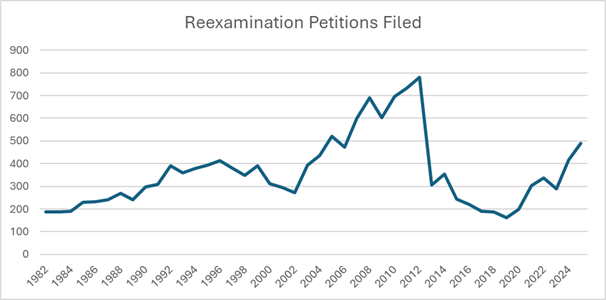
But the period from 2013 to 2019 saw a notable decline in reexamination petitions, with the average annual filings dropping below 240 over that timeframe. That decline in reexamination filings coincided with the implementation of certain provisions of the America Invents Act (AIA) of 2011, which introduced post-grant review (PGR) and inter partes review (IPR) as alternatives to reexaminations that provided broader grounds for challenge and more robust discovery. As these new procedures became the preferred routes for contesting patent validity, traditional reexamination petitions fell out of favor.
Recent Data on Reexamination Filings
Recent court decisions narrowing the scope or applicability of IPR, along with procedural mechanisms for discretionary denial and estoppel provisions, have renewed interest in reexaminations. Economic uncertainties and an increasingly competitive innovation environment have also prompted more stakeholders to seek cost-effective options for challenging patents.
The result was a recent uptick in reexamination activity supported by USPTO statistics indicating a year-over-year increase of over 20% in ex parte reexamination filings from 2020 to 2025, with 491 petitions for reexamination being filed in 2025. This surge is particularly notable among high-value technology and pharmaceutical patents, where patent validity is frequently contested. Stakeholders are increasingly turning to reexamination as a strategic tool, especially when other avenues, such as IPRs, are unavailable or less advantageous due to timing, estoppel, or discretionary denial limitations.
Takeaways
The resurgence in reexamination petitions at the USPTO reflects a dynamic interplay of legal, economic, and policy factors. For legal professionals and business leaders, staying informed about these trends is crucial for making strategic decisions regarding patent enforcement and defense. As the intellectual property landscape continues to evolve, reexamination will remain a vital tool for ensuring patent quality and managing litigation risks. Ongoing monitoring of USPTO practices and legislative developments will be essential for anticipating future shifts and leveraging reexamination effectively.

